|
The talk includes two of Nietzsche's dreams from his childhood. The first of the dreams is of his deceased father arising from the grave and taking Nietzsche's two-year old brother back to the grave. Julia Lockheart's painting of the dream, and the PowerPoint of the talk, are below. 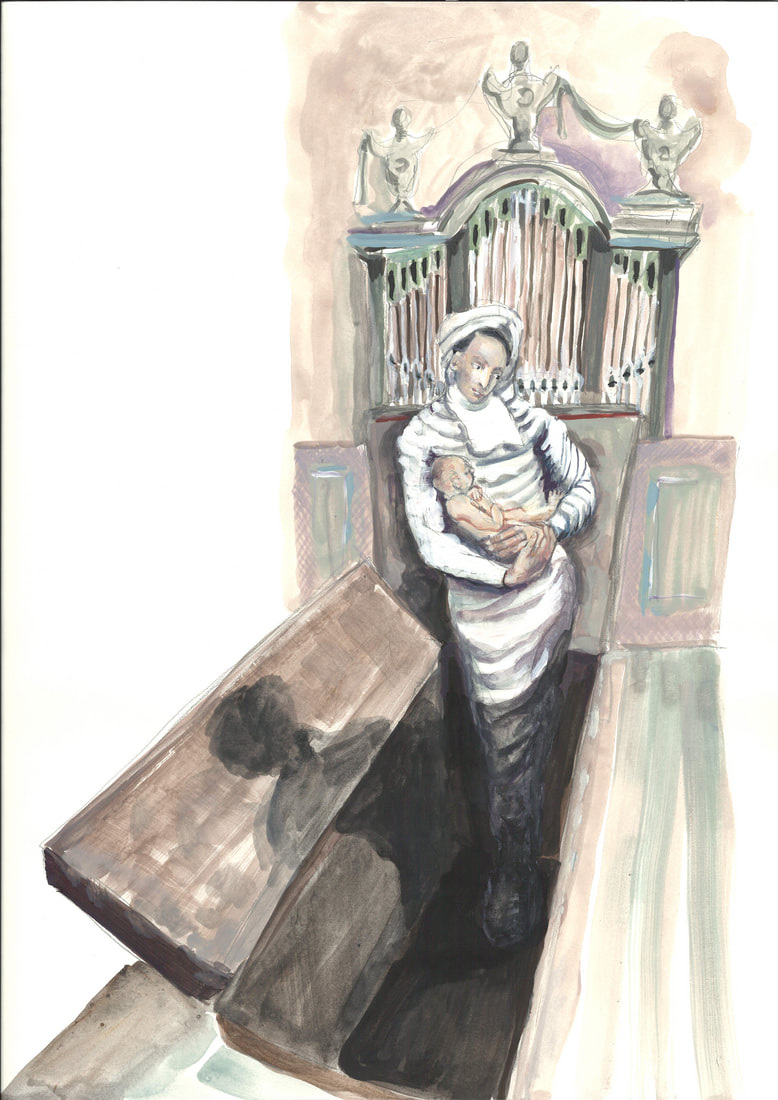
0 Comments
After our Dream Salon illustrating beneficial methods for discussing and interpreting dreams (details here) Mark Blagrove gave a talk on the possibilities for malign uses of dream apps in advertising, cults and religion. The PowerPoint for the talk is below. Review due to be published in the Spring issue of Dream Time, magazine of the International Association for the Study of Dreams. This is a wonderful, captivating, wide-ranging and very original book. It is a clear description of all aspects of research into dreaming and the experience of dreams. It ranges from what is happening in the brain when we dream, to dream content, types of dreams, dream analysis, nightmares, psychoanalysis, disorders of sleep and dreaming, and the technology now being used to alter our dreams. And the debates on whether dreaming has a function, and how we can even experiment to test these theories, are also explained well. As a journalist and science writer the author of course writes beautifully, all is clear, no redundancies, and even highly technical scientific methods are described so that the average reader will understand and appreciate how the science is done. Even people with a lifelong interest or work in this field will benefit from the breadth of the book. But for those experts, and for the general reader, one additional feature makes the book unique and extremely valuable. There are captivating and enlightening interviews with the major dream researchers from the twentieth and twenty-first centuries. Many of these people I have known or knew for years, but the interviews of how and why they became sleep and dream researchers, and details of what they were doing when growing up, was eye-opening for me. And some of the details, such as the family life of Eugene Aserinsky, the co-discoverer of REM sleep with Nathaniel Kleitman, are very poignant. Reading this bestselling book it is clear that Karen van Kampen has not just immersed herself in all areas of the research and practice in this field, but has engaged in long conversations across many years with those researchers and practitioners. The book is thus perfect in explaining where the field of dream research is now, it is completely up-to-date for 2026, and also how at theoretical, experimental and personal levels the field has developed over more than 100 years. The full review can be read below. Our paper on using ChatGPT for dream interpretation, with a protocol, materials and data for the quantitative evaluation of these interpretations, can be downloaded here or read below. The citation for the paper is: Blagrove, M., Roklicer , L., Bueno, J., Austin, O., Foster, H., & Webb, M. (2026). Ratings of insight following dream interpretation by ChatGPT. International Journal of Dream Research, 19, 105–114. Paper by Mark Blagrove and co-authors on how brain injury can result in dream recall being stopped, or for other, occurrence of nightmares to increase. Paper is available here.
Highlights
Mesial frontal and temporoparietal brain areas differ in activity between high and low dream recallers, and lesion studies have found cessation of dreaming in patients with damage to these areas. This study extends these findings by assessing the relationship of dream cessation, and dream and nightmare frequencies, to severity of injury in patients at a head trauma clinic. 52 participants (M = 36, F = 16; mean age = 39.69, SD = 13.72) completed a questionnaire assessing frequency of dreams, nightmares and night terrors, tests for depression and anxiety, and a neuropsychological examination and test battery. 34.6 % of patients reported that they do not dream, which is comparable to Solms' (1997) finding of 34.9 % in his brain injury sample. This contrasts with the rate of not reporting dreams in the general population of 6.1-7.1 %. Dream cessation participants had significantly greater severity of brain injury as measured by the Glasgow Coma Scale and post traumatic amnesia, but cessation was not related to neuropsychological scores. Compared to the general population there was a higher prevalence of weekly nightmares (13.5 %) and also of reporting never having nightmares (48.1 %), the former predicted by anxiety, the latter by brain injury severity. The data cannot distinguish between whether brain injury is halting the production of dreams or causes failure to encode and recall dreams on waking. Future studies using within-sleep behavioral or imaging methods may distinguish between these possibilities. Future studies should also determine if recovery of dream experience is predictive of more global recovery from brain injury. The abstract for the conference presentation on ChatGPT and dream interpretation shown in the post below has now been published.
Blagrove, M., Roklicer, L., Bueno, J., Austin, O., Foster, H. & Webb, M. (2025). Assessment of exploration-insight gains following ‘discussion’ of a dream using ChatGPT. International Journal of Dream Research, 18 (Supplement 1), S24. https://journals.ub.uni-heidelberg.de/index.php/IJoDR/issue/view/7416/1345 Assessment of exploration-insight gains following ‘discussion’ of a dream using ChatGPT Edwards et al. (2013, 2015) showed that the Ullman technique of discussing dreams leads to similar scores on the exploration-insight subscale of the Gains from Dream Interpretation (GDI) questionnaire as occurs for exploration of dreams with a therapist. The Ullman technique uses a relatively atheoretical mapping of dream content onto recent waking life. The current study aims to test whether ChatGPT, if given a participant’s dream report, a report of their recent waking life, and free associations to the dream, can emulate an Ullman discussion of a recent dream. The Gains from Dream Interpretation questionnaire was used to assess participants’ evaluations of the ‘discussion’ output of ChatGPT regarding their dream. 24 participants completed the study (Males, n = 5; females, n = 19; mean age = 31.39). Mean insight-exploration subscale score = 6.73 (SD=1.47), which is significantly lower than means for this variable in studies by Edwards et al., Blagrove et al., and Hill. Personal insight subscale score of 6.03 (SD=1.75) did not differ significantly from the mean score of 6.60 (SD=1.43) in Edwards et al. (2015). The item ‘Overall, how accurate do you find the ChatGPT interpretation of your dream?’, with responses rated from 1 = extremely inaccurate to 9 = extremely accurate, had mean score = 7.33 (SD=1.14). Participants thus saw the ChatGPT dream interpretation as very or moderately accurate, with personal insight occurring, but with exploration of the dream being less thorough and involving than in group discussions. Edwards, C., Malinowski, J., McGee, S., Bennett, P., Ruby, P. & Blagrove, M. (2015). Comparing personal insight gains due to consideration of a recent dream and consideration of a recent event using the Ullman and Schredl dream group methods. Frontiers in Psychology 6, 831. Edwards, C. Ruby, P. Malinowski, J. Bennett, P. & Blagrove, M. (2013). Dreaming and insight. Frontiers in Psychology, 4(979) doi:10.3389/fpsyg.2013.00979 Presentation on assessing levels of insight obtained by inputting a dream, recent waking life experiences, and free associations to the dream, into ChatGPT. Presented by Mark Blagrove and colleagues at the 42nd annual conference of the International Association for the Study of Dreams, 22nd June 2025. Thanking Bill Domhoff who has found a 1983 article by Calvin S. Hall which undertakes a quantitative analysis of 293 dreams of the composer Richard Wagner. The dreams were recorded by Wagner's wife, Cosima, in her daily diaries from 1869 to 1883. The article was in Psychology Today and is so far undigitized, only available in hard copy. Full article is below. For citation please use: Calvin S. Hall, (1983). Wagnerian dreams. Psychology Today, 17 (number 1, January), 34-39. 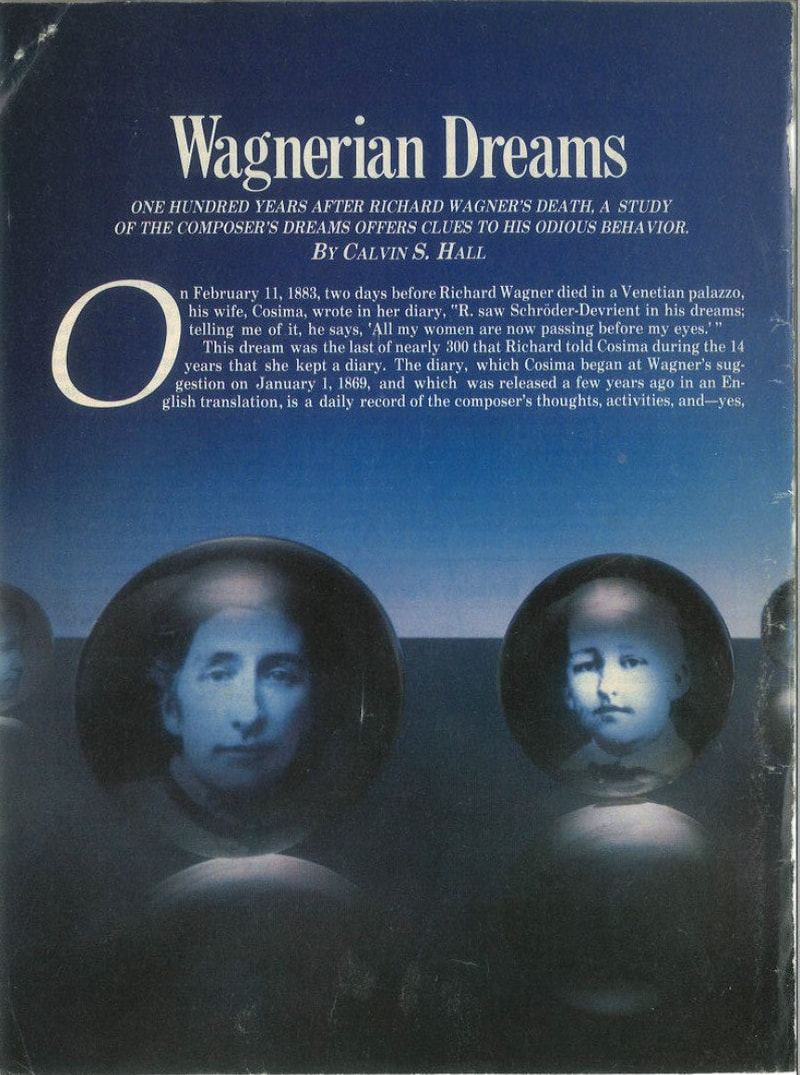 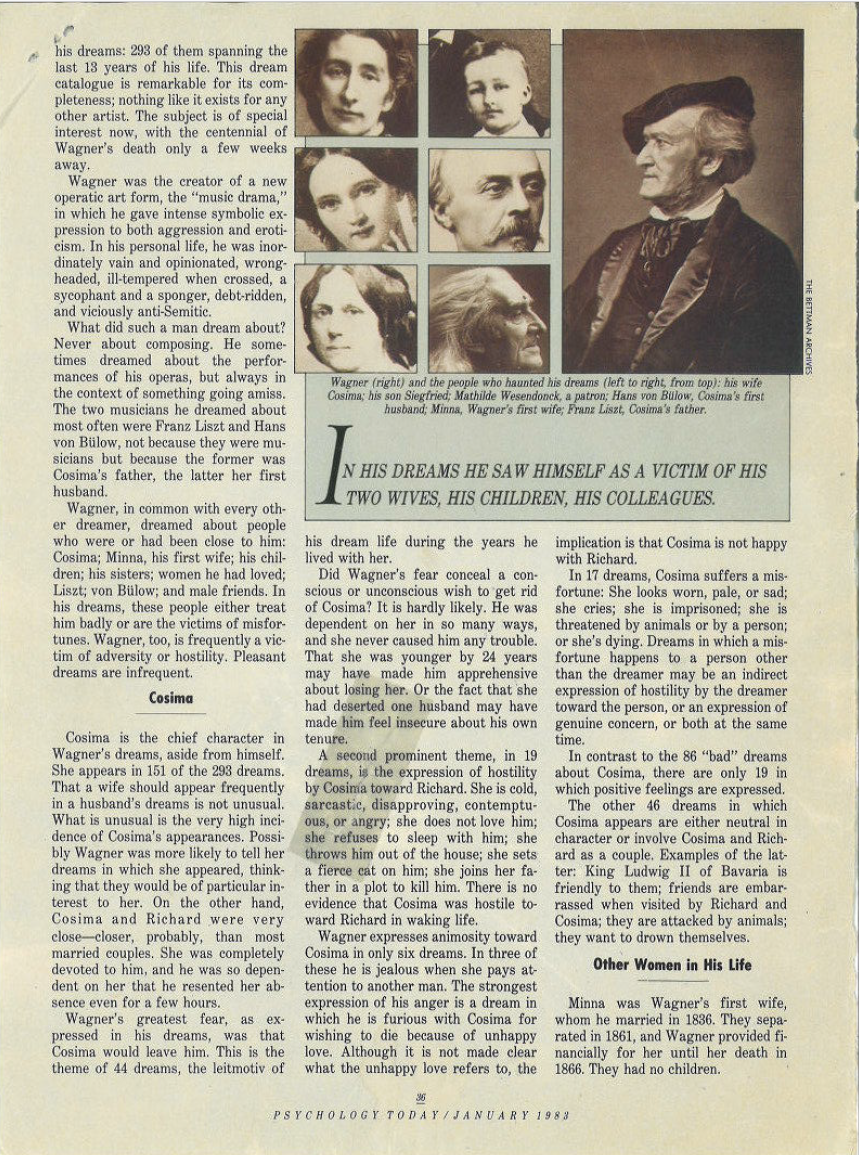 Article in the British Psychological Society magazine The Psychologist on debates about the possible function of dreaming, and whether dreaming might have a function when dreams are told, in contrast to the many proposed within-sleep functions of dreaming. Adapted from chapters 12, 13 and 17 of Blagrove, M. & Lockheart, J. (2023) The Science and Art of Dreaming. Routledge. Main image by Julia Lockheart. www.bps.org.uk/psychologist/does-dreaming-have-function 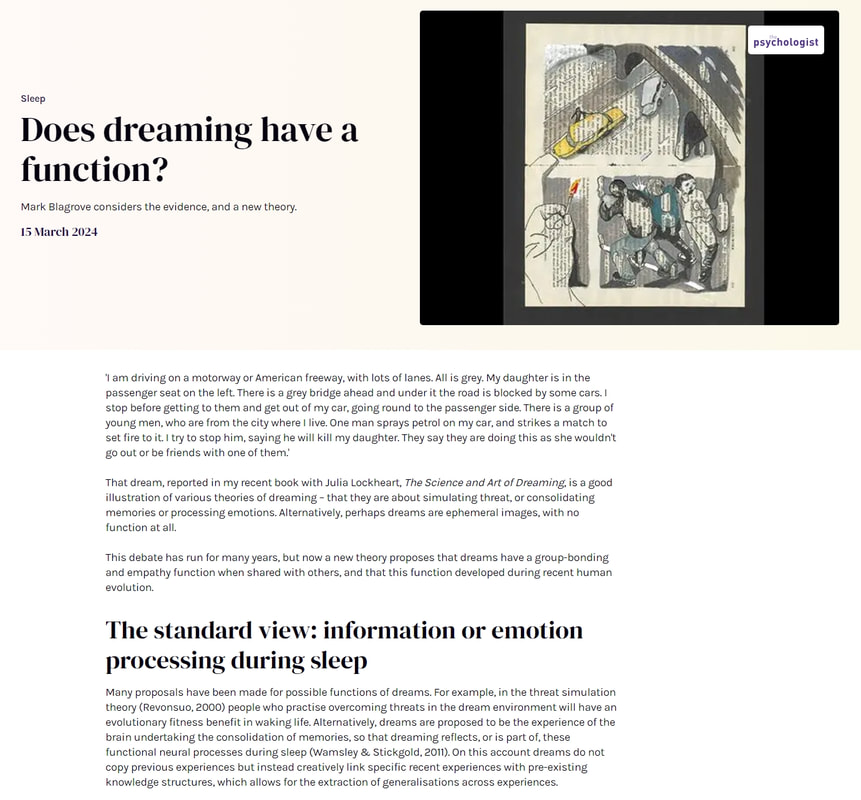 Article on the group-bonding effects of dream-sharing, including discussion on the link between this proposed effect and human self-domestication. Article has artworks from our events and link to the video of our Dream Salon at Cabaret Voltaire in 2023. https://psyche.co/ideas/the-reason-we-dream-might-be-to-bring-us-closer-together 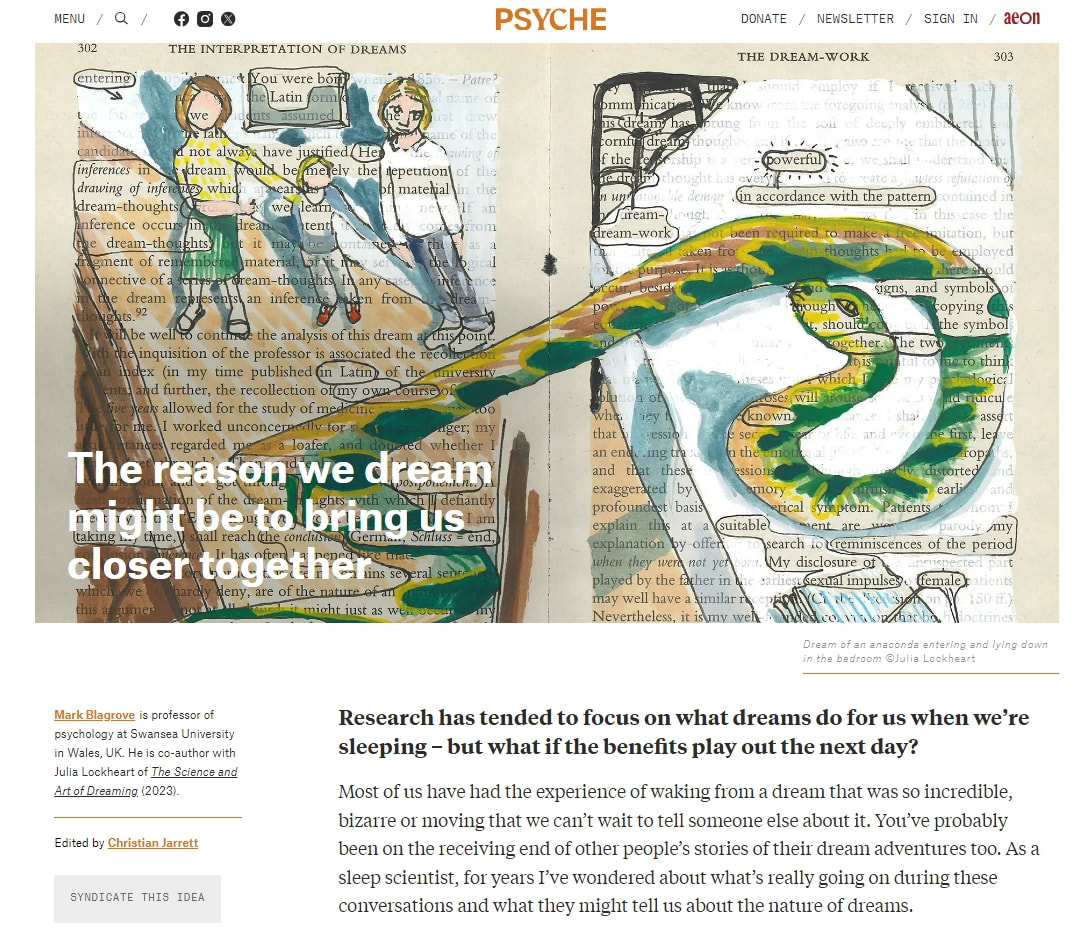 |
AuthorMark Blagrove Archives
May 2026
Categories |
 RSS Feed