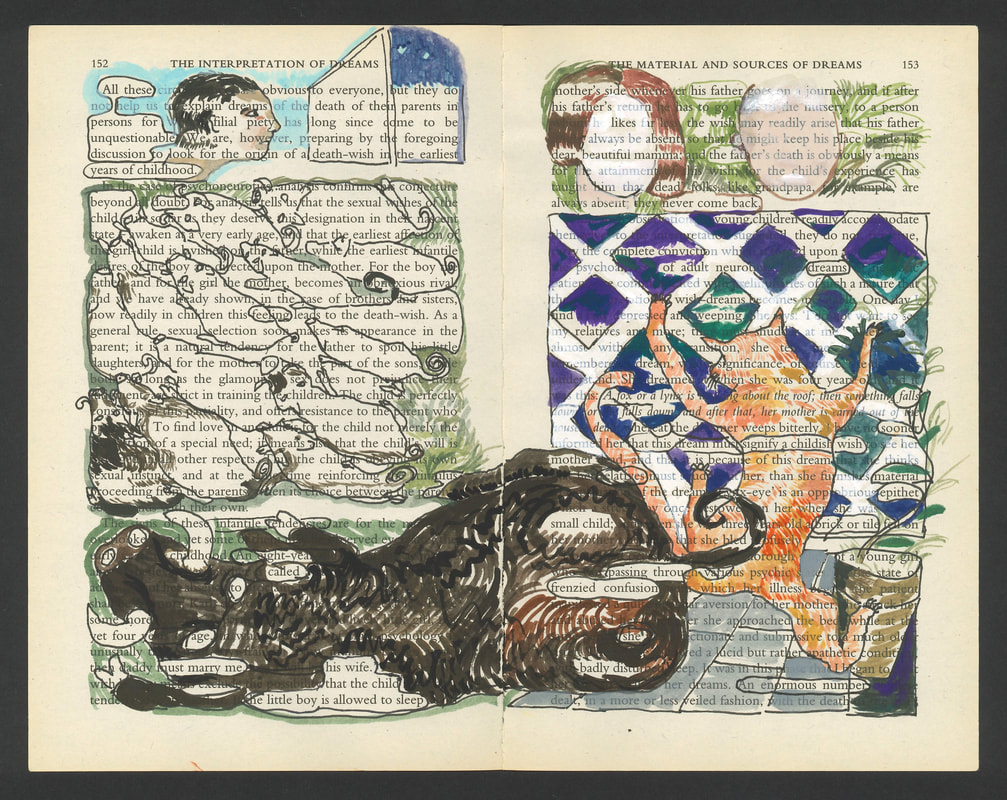
 Whereas we usually discuss and paint a dream that is told to us live by the dreamer, here we took a dream of André Breton, the founder of Surrealism, published in 1924, as part of a symposium, at the 41st IASD conference, commemorating the centenary of the creation of Surrealism and the publication of The Manifesto of Surrealism. 'I arrive at Paris and descend the staircase of a train station very like the Gare de l'Est. I experience an urge to urinate, and get ready to cross the square, on the other side of which I know I'll be able to relieve myself, when a few steps away on the same platform I discern a urinal of small dimensions, in a new and very elegant model. I am no sooner there than I ascertain the mobility of this urinal and become aware, as I am not alone there, of the inconvenience resulting from this mobility. After all it is a vehicle like any other, and I decide to remain on the platform. From that place I observe the disquieting manoeuvers, not far from us, of a second "flying-urinal" similar to ours. Failing to draw the attention of my fellow travellers to the disordered movement and the consequent risk to pedestrians, I step down and succeed in persuading the the imprudent conductor to give up his seat and follow me. He is a man under thirty who, on being questioned, proved quite evasive. He lets on that he is a military doctor in possession of a driving license. Being a stranger to the city where we are, he makes it known that he comes "from the back country" [de la brousse] with no other details. I try to convince him that although he is a doctor that he may be sick, but he enumerates the symptoms of my illnesses, starting with the different fevers. He shows none of these symptoms, which anyway belong to the simplest clinical category. He concludes his explanation with these words: "At worst I have general paresis" [the most malignant form of syphilis]. The examination of his reflexes that I at once undertake, is not conclusive (normal patellar ligament, feeble Achilles ligament, called tendinous in the dream). I forgot to say that we have stopped at the threshold of a white house and that my interlocutor constantly goes up and down a flight of steps one story high. Following my examination I try vainly to learn how he spent his time "in the back country." While making a new ascent of the steps he finally recalled that he had put together a collection there. I insist on knowing the contents of the collection. "A collection of five shrimps" [he says]. He descends the steps again: "I swear to you, dear friend, that I am very hungry," and so saying he opens a straw valise I had not noticed before. He profits from the occasion to let me admire his collection, made up of five shrimps of very different size and looking like a fossil (the hardened carapace is empty and absolutely transparent). But innumerable intact carapaces fall to the ground when he raises the upper part of the valise. He answers my astonishment, "No, there are only five—those over there." From the bottom of the valise he takes out a roasted back of rabbit, and with nothing but his hands he sets about eating by scraping with his nails on its vertebral column. The flesh is distributed in long filaments like that of rays [fish] and seems to have a pasty consistency. I can hardly stand this disgusting spectacle. After a rather long silence my companion says to me: "You will always recognize criminals by their immense jewels. Remember that there is no death, only reversible directions [or senses]." ' Dream reprinted from Spector, J.J. (1989). André Breton and the Politics of Dream: Surrealism in Paris, ca. 1918–1924. American Imago, 46, No. 4 (Winter 1989), pp. 287-317. https://www.jstor.org/stable/26303837. Dream originally published in the first issue of La Révolution surréaliste, December 1924. Spector writes that the flying urinal and valise both represent Marcel Duchamp, referring to Duchamp’s readymade Fountain (1917), a urinal bought from a hardware store, and to Duchamp’s production of small suitcases which contained many miniature reproductions of his artworks. An article on such Boîte-en-valise / box in a suitcase is here and a photograph of one, with a miniature of Fountain, is below. Spector suggests that the dream is based on Breton’s appreciation of Duchamp’s unique ‘elusiveness’ and ‘intellectual equivocation’ while asserting his own superiority and prudence, ‘attentive to the safety of others (the risks of the flying urinal, ignored by others)’ and being a ‘real doctor’, parading his ‘army medical training and technical vocabulary’. Spector highlights Breton’s ‘disgust with Duchamp’s greedy gesture of pulling a rabbit out of his valise rather than a top hat – a post-Dada trick of a kind that Breton had rejected.’ He also states that the penultimate sentence of the dream, on recognising criminals, ‘brings to mind his identification with the glamorous role of the criminal Fantômas. The Surrealists admired this popular film character for defying the police and for his ability to slip through the net of bourgeois authority.’ To Spector this alludes to Breton’s ‘position as antibourgeois revolutionary’. In this symposium Mark Blagrove described the history of surrealism from the First Manifesto in 1924; Bernard Welt (Corcoran School of the Arts and Design at The George Washington University) reviewed and showed clips of surrealist films and also films, such as of Buster Keaton, beloved by the surrealists; Loren Goodman (Yonsei University, South Korea) reviewed and gave examples of Dadaist and Surrealist poetry, including that of Tristan Tzara, and then led the attendees in the production of exquisite corpses, each comprised of lines taken from different dreams of the attendees. At the start of the symposium Mark had read out Breton's dream and Julia found pages on which to paint it. At the end of the symposium Julia showed the final painting and described how she had composed it, including how she had chosen one page (used for the left page of the painting) because at the top it had a short indented poem which she used to create the shape of the urinal. A five-line footnote at the bottom of the right-hand page was used for painting the five shrimps. The finished artwork was exhibited at the gallery of the American University of Paris as part of commemorations for the centenary of the founding of Surrealism. 
0 Comments
 I am looking out of an upstairs window at night. I see a valley and a churning brown river flowing uphill, all lit by the moon. I look closely and see that the river is in fact a herd of wild boar running up a hill, the light on their fur looks like a rippling brown river. I look again and now see it is only one boar, running through the undergrowth. I am then in the lower back garden patio of my childhood home, which is an old Victorian house. The patio is square, concrete, and sunken. It is surrounded by a trellis with green plants growing on it. My cat Mumu is climbing amongst the greenery in the trellis. I want to hold him, but he does not want to be held and eludes each of my grasps by hiding amongst the plants. I get hold of him and see that he is wounded, with a graze that is forming a scab on his right side. I feel guilty for not keeping him safe and fear that when my wife sees that he is wounded I will be blamed.
|
AuthorDr Julia Lockheart Categories |


 RSS Feed